


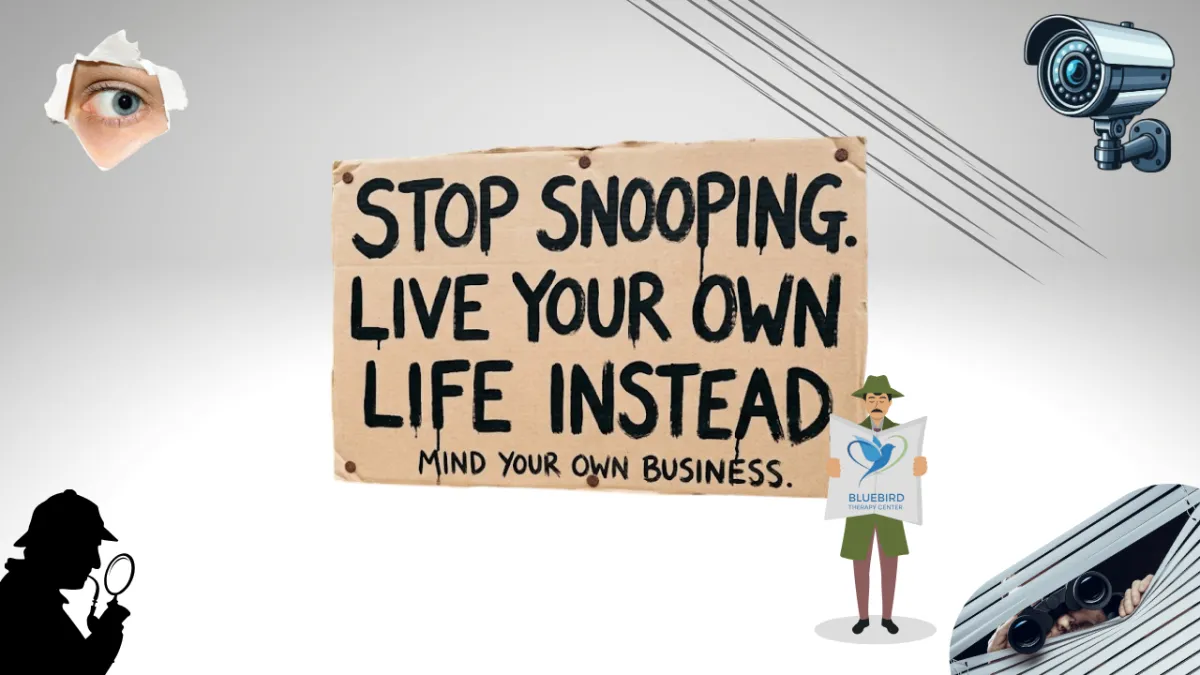
Stop Snooping. Live Your Own Life Instead.
You know exactly what we are talking about.
The quick glance at your partner's phone when they leave the room. The extra second you linger near a conversation that was not meant for you. The deep scroll through the social media of someone you have not spoken to in years. The refresh of a coworker's LinkedIn to see what they are up to now. The eavesdrop at the next table because they said something interesting and you cannot help yourself. Looking up a family members business.
Almost everyone does some version of this. Most people do not talk about it. And almost nobody stops to ask the harder question underneath the behavior.
Why are you actually doing it?
At Bluebird Therapy Center in New Jersey, we work with people navigating exactly the kind of quiet, everyday habits that seem harmless on the surface but are quietly saying something important about what is going on underneath. Snooping is one of them. And it deserves an honest look.
Snooping Is Not About Them. It Is About You.
This is the sentence you need to sit with. Because as long as snooping is about the other person, about what they might be hiding, what they might be doing, what you might catch, it stays external. You get to be the one gathering information. The vigilant one. The smart one. The one ahead and informed.
But that framing is not honest. And the moment you drop it, the whole picture changes.
Snooping is almost always about the snooper. Specifically, it is about a feeling inside the snooper that is uncomfortable enough to demand action, and that action ends up being surveillance because surveillance feels like control. The feelings underneath are usually some combination of the following:
Insecurity. A quiet, persistent fear that you are not enough, not chosen, not the priority. Snooping temporarily interrupts that fear by giving you the illusion of certainty.
Jealousy. A more focused version of the same fear, often attached to a specific person or scenario. Snooping is what you do when you cannot tolerate the feeling of not knowing.
Anxiety. A generalized sense that something is wrong somewhere and you need to find it. Snooping becomes a compulsive behavior aimed at proving or disproving a threat.
A trust wound. Something in your history, either in this relationship or a previous one, taught you that trust is dangerous. Now you are gathering evidence for a case you started building years ago.
None of these are moral failings. They are real internal states that deserve attention. But they are not addressed by looking at someone else's life. They are only addressed by looking honestly at yourself.
The Honest Question to Ask
Before you scroll, snoop, or eavesdrop, try this. Stop and ask yourself one question.
What am I actually afraid of finding?
Sit with it for a second. Do not answer quickly. If the honest answer is something like "I am afraid they do not love me the way I want them to," that is worth knowing. That is the real conversation. Snooping will not resolve it. Even if you find nothing, the fear will come back tomorrow. Even if you find something, you will now have information gathered in a way that will fracture the trust in the relationship even further.
The uncomfortable truth is this. If you have to snoop to feel okay, the snooping is not the solution. It is the symptom.
The Cost of Living in Someone Else's Life
There is another layer to this. Snooping does not just fail to solve the internal problem. It actively drains you of the one thing you cannot get back.
Time.
Every minute you spend monitoring someone else is a minute you are not spending inside your own life. Every hour scrolling through an ex's Instagram, hovering near a conversation you were not part of, or refreshing someone's page to see if they are thriving without you is an hour you gave to a life that is not yours.
Think about what you actually did today. How much of your mental energy went to your own goals, your own health, your own relationships, your own projects, your own growth? And how much went to watching, tracking, comparing, wondering, and checking on other people?
Most people who honestly answer that question realize something uncomfortable. They are living in other people's lives more than their own.
The Reframe That Changes Everything
Here is the shift. Your attention is your most valuable resource. More valuable than money, because you can earn more money. You cannot earn more attention. What you focus on is what you build.
If your attention is going to what someone else is doing, saying, wearing, earning, or posting, that is the life you are building. A life spent watching. A life spent comparing. A life that never quite feels like yours because you were too busy paying attention to everyone else's to fully live it.
Compare that to a life where your attention comes home. Where the mental energy you have been spending on surveillance and comparison gets redirected to your own health, your own relationships, your own goals, your own presence. That life feels different almost immediately. Not because anything changed on the outside, but because you finally showed up on the inside.
What to Do Instead
Ask directly. If you have a real concern in a relationship, have the real conversation. Snooping is what people do to avoid a hard talk. The talk is uncomfortable. The years of built up distrust that snooping creates are much worse.
Notice what triggered it. Every time you feel the pull to snoop or eavesdrop, notice what happened right before. A specific comment. A shift in mood. A moment of feeling small or forgotten. That trigger is the actual thing worth understanding.
Redirect the attention immediately. When you catch yourself about to scroll or listen in, put the energy somewhere else. A walk. A workout. Actually finishing something you started. The urge will pass faster than you expect.
Get curious about what you are avoiding. People snoop when they do not want to face something in themselves. What is the thing you have been avoiding in your own life? That is where the real work is.
Talk to a therapist. This is often the piece that unlocks all the others. A therapist gives you space to understand what is actually driving the behavior, work through the insecurity, jealousy, or trust wounds underneath it, and build a life where you no longer feel the need to monitor anyone else's.
At Bluebird Therapy Center, we help people build exactly that kind of clarity. We offer virtual therapy sessions for anyone across New Jersey, accept most major insurance plans, and provide a free 15-minute consultation with no pressure and no commitment required.
Book your free consultation today and start building a life you are actually inside of.
Live Your Life.
Let Everyone Else Live Theirs.


