


What Is CBT Therapy and How Does It Work? | Bluebird NJ
What Is CBT? A Clear Guide to Cognitive Behavioral Therapy
If you have ever looked into therapy, you have almost certainly come across the term CBT. It appears on therapist profiles, in mental health articles, and in conversations about treatment for anxiety and depression more than almost any other approach.
But what is it actually? What happens in a CBT session? Who is it for? And is it the right fit for you?
These are exactly the questions worth answering before you start therapy, because understanding the approach helps you get more out of it from day one.
At Bluebird Therapy Center in Bergen County, New Jersey, we work with clients using CBT and other approaches every day. Here is a clear, honest breakdown of what CBT is and what it can do for you.
What CBT Actually Is
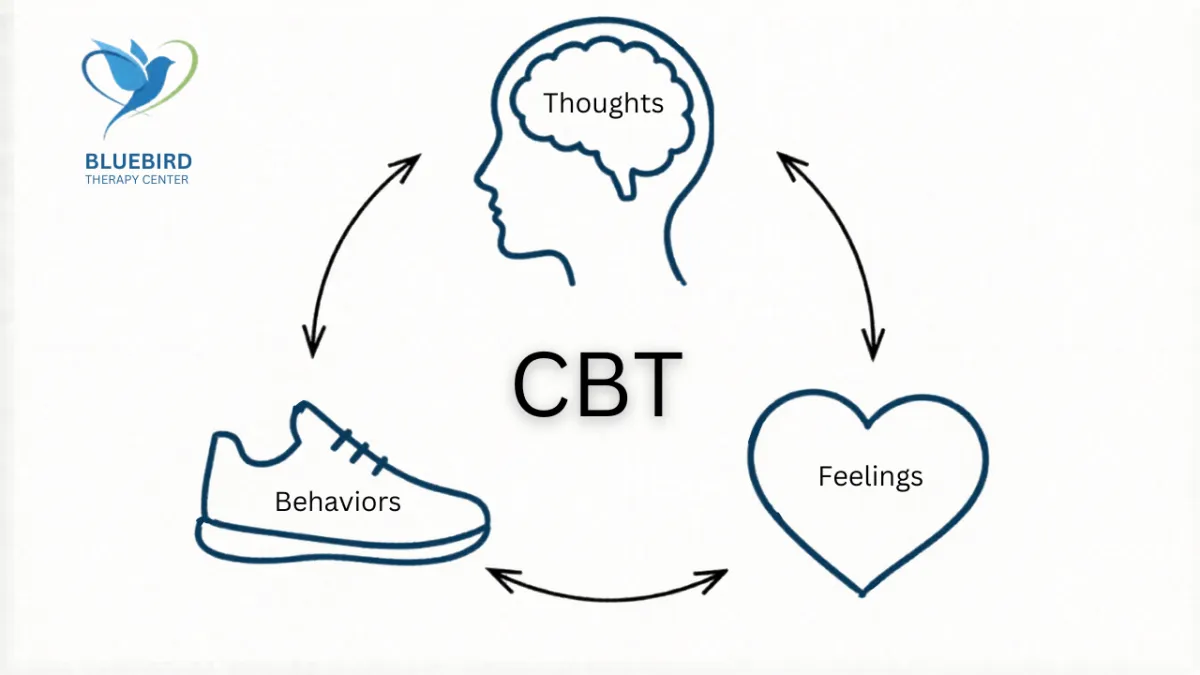
CBT stands for Cognitive Behavioral Therapy. It is a structured, goal-oriented form of psychotherapy built on one central idea: the way you think directly affects the way you feel, and the way you feel directly affects the way you behave.
The three components work in a continuous loop.
Your thoughts influence your emotions. Your emotions influence your actions. Your actions then reinforce your thoughts. This cycle runs constantly in the background of daily life, and when the thoughts feeding the loop are distorted, inaccurate, or overly negative, the emotional and behavioral consequences can be significant.
CBT works by identifying those distorted thought patterns, examining them honestly, and replacing them with more accurate and balanced ways of thinking. The result is not forced positivity or pretending everything is fine. It is a clearer, more realistic relationship with your own mind that reduces unnecessary suffering.
Where CBT Came From
CBT was developed in the 1960s by psychiatrist Dr. Aaron Beck, who was originally trained in psychoanalysis. While working with patients experiencing depression, Beck noticed that they shared a pattern of automatic negative thoughts that were distorted in predictable ways but felt completely true to the people having them.
He began documenting these thought patterns and developing structured techniques for identifying and challenging them. The result was a therapeutic approach that was more structured, more measurable, and more time-limited than traditional psychoanalysis, and the research support for its effectiveness has grown steadily ever since.
CBT is now one of the most studied and validated therapeutic approaches for a wide range of mental health conditions.
What CBT Treats
This is where CBT particularly stands out. It has been studied and applied across a remarkably broad range of conditions including:
Generalized anxiety disorder
Social anxiety and social phobia
Panic disorder and panic attacks
Depression and persistent low mood
Obsessive compulsive disorder
Post-traumatic stress disorder
Phobias of all kinds, including the ketchup variety
Insomnia and sleep disorders
Eating disorders
Relationship difficulties rooted in thought and behavior patterns
Stress and burnout
It is also used effectively with people who do not have a clinical diagnosis but are dealing with negative thinking patterns, low self-esteem, or behavioral habits they want to change.
What Actually Happens in a CBT Session
One of the things that makes people hesitant about therapy is not knowing what to expect when they walk in. CBT has a specific structure that takes some of the mystery out of it.
Sessions typically begin with a check-in on the week, including any homework exercises from the previous session. The therapist and client then work together on identifying specific thoughts, feelings, and behaviors that came up during the week and examine them through the lens of CBT principles.
Key techniques used in CBT include:
Thought records. You write down a situation, the automatic thought that followed, the emotion it produced, and then examine whether the thought is accurate or distorted. This is one of the most powerful tools in CBT because it makes invisible thought patterns visible and therefore workable.
Cognitive restructuring. Once a distorted thought is identified, the therapist helps you develop a more balanced, realistic alternative thought. This is not about lying to yourself. It is about being as accurate as possible rather than defaulting to the worst case interpretation.
Behavioral experiments. You test assumptions by actually doing the thing you have been avoiding and observing what actually happens versus what you predicted. This is particularly powerful for anxiety and phobias.
Homework. CBT does not happen only in the session. You practice skills between appointments. This is one of the reasons CBT tends to produce lasting change rather than just in-session insight.
How Long CBT Takes
Unlike some therapeutic approaches that are open-ended, CBT is typically structured and time-limited. Many people see meaningful improvement within 12 to 20 sessions, though this varies depending on the complexity of what is being addressed.
This is genuinely good news for people who are hesitant to commit to an open-ended process. CBT gives you a framework, specific tools, and a clear direction from the beginning.
Is CBT Right for You?
CBT works best for people who are ready to engage actively in their treatment. It requires showing up, practicing skills between sessions, and being willing to examine your own thinking patterns honestly. It is collaborative and direct rather than passive.
If you are dealing with anxiety, depression, negative thought loops, behavioral patterns you want to change, or simply a persistent sense that your mind is working against you rather than for you, CBT is absolutely worth exploring.
Bluebird Therapy Center offers virtual CBT-informed therapy sessions for anyone across New Jersey. We accept most major insurance plans and offer a free 15-minute consultation so you can ask questions and get a real sense of the process before committing to anything.
Book your free consultation today and take the first step toward thinking differently about your own thinking.


