


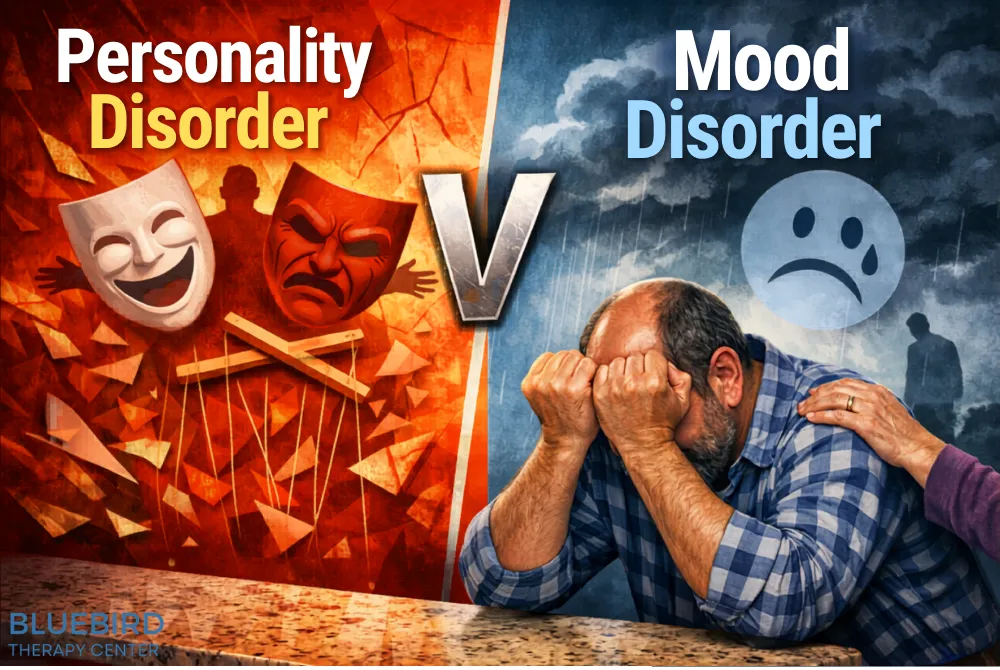
Personality Disorder vs Mood Disorder: What's the Difference?
Personality Disorder vs Mood Disorder: What's the Difference
Mental health terminology gets thrown around a lot, online, in conversations, on social media, and in therapy waiting rooms. And twocommonly confused categories are mood disorders and personality disorders.
People use these terms interchangeably sometimes. They are not the same thing. The distinction matters because these two categories affect people differently, develop differently, look different in relationships, and require different approaches to treatment.
Understanding the difference is not just academic. It could be the thing that helps you finally make sense of what you or someone you love has been experiencing for years.
At Bluebird Therapy Center in New Jersey, we believe that understanding your mental health is part of improving it. Here is a clear breakdown of what separates these two categories and what they share.
What Is a Mood Disorder?
A mood disorder is exactly what it sounds like at its core. It is a mental health condition in which a person's emotional state is significantly disrupted in a way that interferes with daily functioning.
The key word here is episodic. Mood disorders are generally periodic, showing symptoms transiently, meaning they tend to come in waves, episodes, or cycles that a person moves through rather than a fixed permanent state of being.
Common mood disorders include:
Major Depressive Disorder. Persistent and deep sadness, loss of interest, low energy, and changes in sleep and appetite that last weeks or longer.
Bipolar Disorder. Alternating episodes of depression and mania or hypomania, including periods of elevated mood, reduced need for sleep, increased impulsivity, and elevated energy.
Persistent Depressive Disorder. A lower-grade but chronic form of depression that lingers for years.
Seasonal Affective Disorder. Mood disruptions tied to seasonal changes in light exposure, most commonly in winter months.
Mood disorders primarily affect how a person feels inside. The storm is largely internal, though it absolutely affects behavior and relationships. Critically, mood disorders often respond well to a combination of therapy and, in many cases, medication.
What Is a Personality Disorder?
A personality disorder is a fundamentally different category. Rather than being about disruptions in emotional state, a personality disorder involves deeply ingrained, long-standing patterns of thinking, feeling, behaving, and relating to other people that are rigid, pervasive, and consistently cause distress or difficulty in functioning.
Personality disorders are characterized by enduring patterns of behavior, cognition, and inner experience that are abnormal, pervasive, and lead to distress. These patterns typically begin in adolescence or early adulthood and persist across different situations and relationships over time. They are not reactions to specific circumstances. They are the baseline.
Common personality disorders include:
Borderline Personality Disorder (BPD). Intense emotional swings, unstable relationships, a fragile sense of identity, fear of abandonment, and impulsive behavior.
Narcissistic Personality Disorder (NPD). A pervasive pattern of grandiosity, need for admiration, and limited capacity for empathy toward others.
Avoidant Personality Disorder. Extreme social inhibition, feelings of inadequacy, and hypersensitivity to criticism that lead to significant avoidance of relationships.
Obsessive-Compulsive Personality Disorder. A preoccupation with order, control, and perfectionism that interferes with flexibility and relationships.
There are ten recognized personality disorders in the DSM-5, the diagnostic manual used by mental health professionals, and they are grouped into three clusters based on shared characteristics.
The Three Key Differences
1. Duration and Pattern
Mood disorders tend to be episodic. A person with major depression may experience a serious depressive episode and then a period of relative wellness. Someone with bipolar disorder cycles between distinct mood states. There is movement.
Personality disorders are consistent across contexts. The patterns show up in work relationships, romantic partnerships, friendships, and family dynamics. They do not come and go. They are present across the full landscape of a person's life. Start My Wellness
2. What Is Primarily Affected
Mood disorders are defined by persistent disruptions in an individual's emotional state, whereas personality disorders are defined by unhealthy and unstable patterns of thought, emotion, and behavior that cause difficulties in interpersonal relationships. Socalmentalhealth
Put simply, mood disorders are primarily about how a person feels. Personality disorders are primarily about how a person thinks, behaves, and relates to others.
3. Response to Treatment
Individuals suffering from mood disorders exhibit more positive and rapid responses towards medications and psychotherapy, while for personality disorders, long-term psychotherapy is more significant and reaps better results. Bpwimh
This does not mean personality disorders are untreatable. It means they require a sustained, specialized therapeutic approach. Dialectical Behavior Therapy, for example, was specifically developed for Borderline Personality Disorder and has a strong track record. Progress with personality disorders is absolutely possible. It typically requires more time and a higher level of therapeutic commitment.
Where It Gets Complicated: The Overlap
Here is what makes diagnosis genuinely difficult even for trained clinicians. Mood disorders and personality disorders share a significant number of symptoms. Emotional dysregulation, irritability, relationship difficulty, impulsive behavior, and social withdrawal can appear in both categories.
It is also very common for a person to carry both a mood disorder and a personality disorder at the same time. Someone with Borderline Personality Disorder, for instance, frequently also meets criteria for depression or an anxiety disorder. These conditions do not arrive in neat, separate packages.
This is exactly why professional diagnosis matters. Trying to self-diagnose based on a social media post or a personality quiz is not the same as a thorough clinical evaluation by someone trained to untangle these overlapping presentations.
Why Getting the Right Diagnosis Changes Everything
The path to feeling better looks different depending on what is actually driving your experience. If you have been treated for depression for years without significant improvement, it may be worth exploring whether there is a personality component that has not been addressed. If a relationship in your life is consistently painful in ways that feel inexplicable, understanding the role of personality patterns, in yourself or the other person, can be genuinely clarifying.
None of this is about labeling or limiting anyone. It is about understanding what is actually happening so that the right support can be put in place.
Book your free consultation today and get the clarity that a real professional assessment can provide.


