
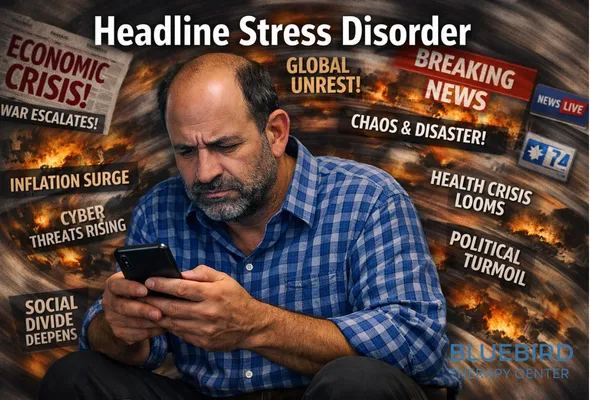
Headline Stress Disorder: When the News Hurts You
Headline Stress Disorder: When the News Is Doing Real Damage to Your Mental Health
You open your phone first thing in the morning. Before your coffee. Before you have said a word to another human being. And within sixty seconds you have read about the economic crisis, a political scandal, a natural disaster, and something that makes your stomach drop in a way that stays with you for the rest of the day.
By the time you put your phone down you are already anxious, already braced, already carrying a weight that was not yours five minutes ago.
If this is your daily reality, you are not alone. And there is actually a name for what you are experiencing.
It is called headline stress disorder.
What Headline Stress Disorder Actually Is
Headline stress disorder is not a formal clinical diagnosis. It is a term coined by media psychologist Dr. Steven Stosny to describe a very real and increasingly common pattern: a persistent state of anxiety, dread, and emotional dysregulation directly tied to excessive or compulsive news consumption.
The American Psychological Association has tracked this trend carefully. Their Stress in America survey found that 73 percent of Americans felt overwhelmed by the number of crises facing the world in 2023. The American Psychiatric Association's 2024 annual mental health poll found that 43 percent of adults reported feeling more anxious than the previous year, up from 37 percent in 2023 and 32 percent in 2022, with 70 percent of adults reporting that current events specifically were a primary source of their anxiety. Psychiatry TimesAmerican Psychiatric Association
This is not a fringe experience. It is a mental health trend affecting millions of people, and it is being driven by something very specific about how modern news is designed and delivered.
Why the News Is Built to Keep You Anxious
Here is something the media industry has known for decades. Negative news gets more clicks, more shares, and more engagement than positive news. This is not cynicism. It is documented human behavior rooted in the brain's negativity bias, the evolutionary tendency to pay more attention to potential threats than to neutral or positive information.
Research published in the Proceedings of the National Academy of Sciences confirmed a cross-national negativity bias in psychosocial reactions to news, and separate research found that negativity actively drives online news consumption. Psychiatry Times
News organizations, whether they intend to or not, are optimized around this bias. The most alarming headline gets the click. The most frightening framing gets the share. And the 24-hour news cycle means the content never stops, which means the stress response it triggers never fully gets to resolve.
Add social media into the equation and the exposure becomes constant, personalized, and nearly inescapable.
What Headline Stress Disorder Feels Like
The signs are worth knowing because a lot of people are experiencing this without connecting it to their news consumption habits.
Common symptoms include:
Waking up and immediately reaching for your phone to check the news before anything else
A persistent low-level dread that follows you through the day after reading or watching the news
Difficulty concentrating at work or in conversation because your mind keeps returning to what you read
Physical symptoms including tension headaches, stomach tightness, and disrupted sleep
A sense of helplessness or hopelessness about the state of the world that feels disproportionate to your actual personal circumstances
Irritability or emotional reactivity that feels connected to news cycles rather than your own life
Compulsively checking news updates throughout the day even when you know it makes you feel worse
That last point is particularly important. The compulsive checking is not a character flaw. It is the same negativity bias loop working against you. Your brain registers threat, wants to monitor it, and keeps returning to the source of the threat in an attempt to stay informed and feel in control. The result is more exposure, more stress, and less actual sense of control.
The Difference Between Being Informed and Being Consumed
There is an important distinction worth making here. Staying informed about the world is reasonable and healthy. Being consumed by it is neither.
You do not need to read seventeen takes on the same story. You do not need breaking news alerts arriving on your wrist every fifteen minutes. You do not need to check the news the moment you wake up or the moment you cannot sleep at three in the morning.
Informed looks like setting aside a specific time to read the news, choosing reliable sources, and then closing the tab and returning to your life.
Consumed looks like news following you everywhere, coloring every moment of your day, and making you feel like the world is always on the verge of catastrophe even when your own life is relatively stable.
The feelings are real in both cases. But only one of them is actually serving you.
What You Can Do About It Right Now
Set a news window. Give yourself one or two specific times per day to check the news and keep them short. Outside of those windows, the apps stay closed. This one change alone significantly reduces the ambient anxiety most people do not even realize they are carrying.
Turn off push notifications. Every breaking news alert that lands on your phone is a micro-stress hit, regardless of how significant the actual story is. You will still find out what matters. You do not need to be interrupted by it constantly.
Choose your sources deliberately. There is a significant difference between news that informs and news that is designed to outrage. Know which one you are consuming.
Replace doomscrolling with something that has a defined end. A book. An episode of something. A conversation. Your brain needs a stopping point that the news will never give you on its own.
Move your body. Physical movement is one of the fastest ways to discharge the stress response that news anxiety activates. Even a ten-minute walk genuinely helps.
Talk to a therapist. If the anxiety triggered by news consumption has become persistent, is affecting your sleep, your relationships, or your ability to be present in your own life, that is beyond what a news diet alone can fix.
When It Is More Than Just the News
For a lot of people, headline stress disorder is landing on top of anxiety that was already there. The news becomes the trigger, but the underlying pattern of anxious thinking, dread, and helplessness has roots that go deeper than any single news cycle.
Therapy gives you the space to understand those roots, build real tools for managing anxiety, and stop living in a state of perpetual threat response.
At Bluebird Therapy Center in New Jersey, we work with clients navigating anxiety in all its forms, including the kind that feels like it is coming from the outside world when it is actually being amplified from within.
We offer virtual therapy sessions for anyone across New Jersey, accept most major insurance plans, and offer a free 15-minute consultation with no pressure and no commitment required.
Book your free consultation today and start getting a handle on the anxiety the news has been feeding.
The World Will Still Be There After You Log Off
You are not going to miss anything important by closing the app. You are not going to be less informed by setting a limit. What you will be is less anxious, more present, and better equipped to actually engage with the world around you rather than just stress about it from a distance.
If you are in New Jersey and the news has been living rent-free in your nervous system, Bluebird Therapy Center is here.


